Steel grating, as a versatile structural component composed of bearing bars and cross bars arranged in a regular grid pattern, is widely used in industrial plants, bridges, platforms, stair treads, drainage covers, and other fields. Its performance, safety, and service life are directly determined by scientific design and strict process control. 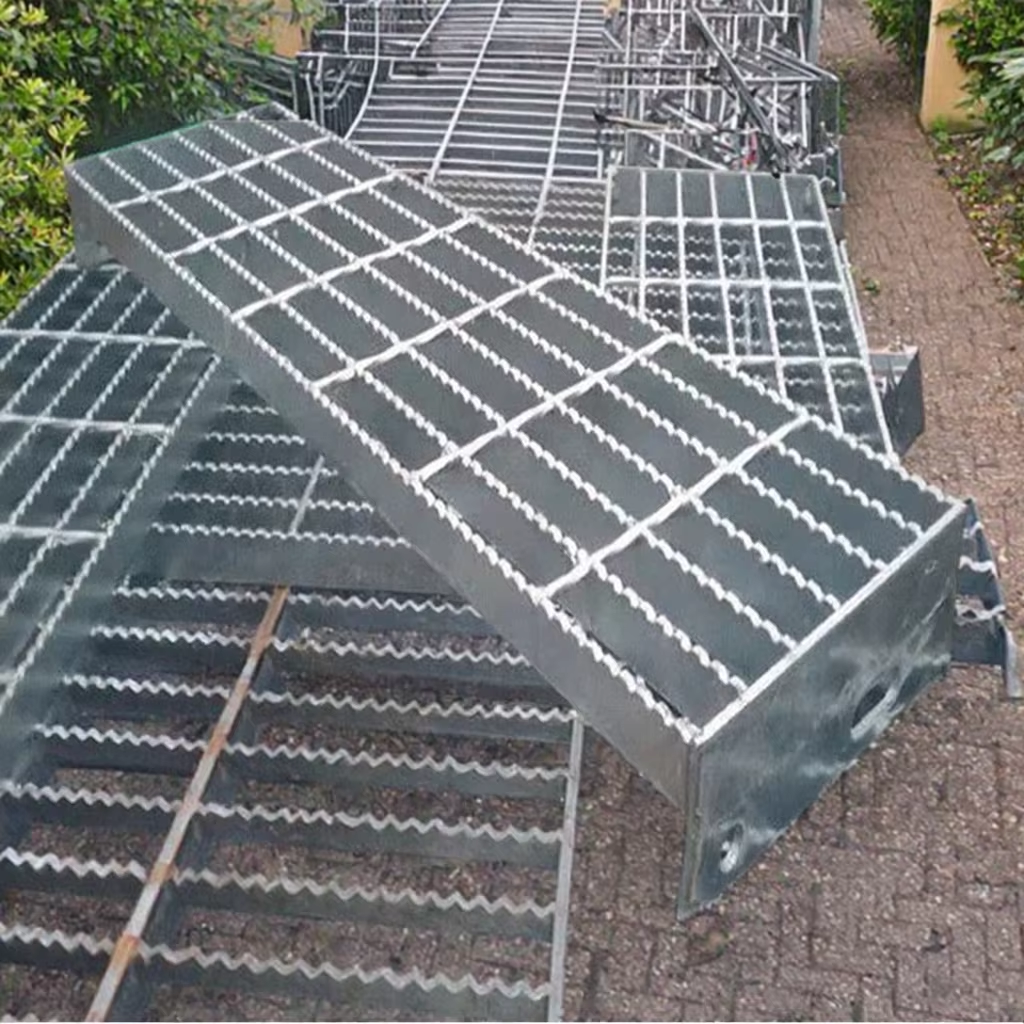
1. Core Design Principles of Steel Grating
The design of steel grating must adhere to three core principles: safety, applicability, and economy, while balancing structural performance and practical needs. Firstly, safety is the primary premise, requiring the grating to withstand specified loads (including static load, dynamic load, and impact load) without deformation, fracture, or structural failure, and to ensure the safety of personnel and equipment. Secondly, applicability requires the design to match the specific use scenario, considering factors such as environmental corrosion, temperature changes, and installation space, so as to meet the functional requirements of ventilation, lighting, drainage, and anti-slip. Finally, economy emphasizes optimizing the design under the premise of meeting safety and applicability, reducing material waste and production costs, without excessive pursuit of over-design.
2. Key Design Requirements for Steel Grating
2.1 Material Selection Requirements
The material of steel grating directly affects its corrosion resistance, strength, and service life, and must be selected according to the use environment and load requirements. Common materials include carbon steel, stainless steel, and galvanized steel. For general indoor scenarios with no corrosion or mild corrosion, carbon steel grating (such as Q235B) is preferred, which has the advantages of high strength and low cost; for outdoor, humid, corrosive (such as chemical plants, coastal areas) environments, stainless steel grating (such as 304, 316L) or hot-dip galvanized carbon steel grating is recommended. Stainless steel has excellent corrosion resistance and durability, while hot-dip galvanizing can form a dense zinc layer on the surface of carbon steel, effectively isolating air and moisture and preventing corrosion. In addition, the material must meet the relevant national standards, with qualified chemical composition and mechanical properties (such as tensile strength, yield strength, and elongation).
2.2 Structural Dimension Design
The structural dimensions of steel grating mainly include the spacing of bearing bars, the spacing of cross bars, the thickness and height of bearing bars, and the overall size, which are determined according to the load capacity and use scenario.
Bearing bars are the main force-bearing components of steel grating, and their height and thickness must be calculated based on the span and load. Generally, the height of bearing bars ranges from 20mm to 100mm, and the thickness ranges from 3mm to 10mm; the spacing of bearing bars is usually 30mm, 40mm, 50mm, etc., and smaller spacing is required for scenarios with larger loads or higher safety requirements (such as pedestrian platforms, stair treads) to ensure stability and anti-slip performance.
Cross bars are used to fix bearing bars and distribute loads, and their spacing is generally 50mm, 100mm, 150mm, etc. The spacing should not be too large to avoid bearing bars bending and deforming, nor too small to avoid increasing production costs and affecting ventilation and drainage. The cross bars can be round steel, flat steel, or twisted steel, among which twisted steel cross bars have better anti-slip performance and are widely used in pedestrian-related scenarios.
The overall size of steel grating should be designed according to the installation space, and the length and width should be matched with the supporting structure. Generally, the length of a single steel grating should not exceed 6 meters to facilitate transportation and installation; if a larger size is required, it can be spliced, and the splicing position should be set at the supporting point to ensure load-bearing capacity.
2.3 Load-bearing and Safety Design
Load-bearing design is the core of steel grating design, requiring accurate calculation of the maximum load that the grating can bear, including static load (such as the weight of equipment, goods) and dynamic load (such as the impact of personnel walking, equipment operation). The calculation should comply with relevant national standards (such as GB/T 3270-2015, ASTM A141/A141M) to ensure that the deflection of the grating under the specified load does not exceed the allowable value (generally 1/300 of the span).
In addition, safety design also includes anti-slip requirements and edge protection. For pedestrian platforms and stair treads, the surface of the grating should be treated with anti-slip measures, such as using twisted steel cross bars, embossed flat steel bearing bars, or adding anti-slip strips, to prevent personnel from slipping; the edge of the grating should be provided with edge bars (the same material as the bearing bars) to enhance the structural stability of the grating and avoid personnel being scratched by the sharp edges of the steel bars.
2.4 Corrosion Protection Design
Corrosion is the main factor affecting the service life of steel grating, so corrosion protection design must be carried out according to the environmental conditions. Common corrosion protection methods include hot-dip galvanizing, cold galvanizing, painting, and stainless steel material selection.
Hot-dip galvanizing is the most widely used corrosion protection method, which requires the zinc layer thickness to be not less than 80μm (for carbon steel grating), and the zinc layer should be uniform, dense, and free of bubbles, cracks, and peeling. Cold galvanizing has a thinner zinc layer (generally 10-30μm) and poorer corrosion resistance, which is only suitable for indoor mild corrosion environments. Painting is suitable for scenarios with special color requirements or temporary corrosion protection, and the paint should be selected according to the corrosion medium (such as anti-corrosion paint for chemical corrosion, anti-rust paint for ordinary humidity), and the painting process should ensure uniform coating and no missing paint.
For highly corrosive environments (such as coastal areas with high salt spray, chemical plants with strong acid and alkali), stainless steel grating or hot-dip galvanized + painting composite corrosion protection measures can be adopted to further improve corrosion resistance.
3. Process Requirements for Steel Grating Production
3.1 Raw Material Processing
The raw materials (bearing bars, cross bars) must be inspected before processing to ensure that their specifications, material properties, and surface quality meet the design requirements. The surface of the steel bars should be free of rust, oil, scars, and other defects; if there is rust, it should be derusted by sandblasting or pickling to ensure the adhesion of the subsequent galvanizing or painting layer.
The bearing bars and cross bars need to be cut according to the designed dimensions, and the cutting accuracy should be controlled within ±1mm. The cut surface should be flat and free of burrs, which can be polished to avoid affecting the assembly accuracy and safety.
3.2 Assembly Process
The assembly of steel grating is to fix the bearing bars and cross bars according to the designed spacing to form a regular grid structure. Common assembly methods include welding and locking.
Welding assembly is suitable for carbon steel grating and stainless steel grating. The welding should be firm, and the weld seam should be uniform and free of defects such as slag inclusion, porosity, and cracks. The welding spot should be arranged reasonably, generally every 50-100mm, and the height of the weld seam should not be less than the thickness of the cross bar. After welding, the weld seam should be polished to make the surface smooth and avoid affecting the appearance and corrosion protection effect.
Locking assembly is a non-welding assembly method, which uses a locking device to fix the cross bar on the bearing bar, with the advantages of convenient disassembly and assembly and no damage to the zinc layer. This method is suitable for hot-dip galvanized steel grating, which can avoid the damage of welding to the zinc layer and ensure corrosion resistance. The locking device should be firm and not loose, and the spacing of the locking points should be consistent with the welding spot spacing.
3.3 Corrosion Protection Processing
Corrosion protection processing is an important process to ensure the service life of steel grating, and the process requirements vary according to the corrosion protection method.
For hot-dip galvanizing processing: first, the assembled steel grating is derusted (sandblasting or pickling) to remove rust, oil, and oxide scale on the surface; then, it is cleaned and dried to ensure the surface is clean and dry; finally, it is immersed in a zinc liquid with a temperature of 450-480℃ for hot-dip galvanizing, and the immersion time is controlled according to the thickness of the steel bar to ensure the zinc layer thickness meets the requirements. After galvanizing, the excess zinc liquid is removed, and it is cooled naturally or forcedly cooled to form a uniform and dense zinc layer.
For painting processing: after assembly and derusting, the steel grating is painted with primer and topcoat. The primer is used to enhance the adhesion of the paint layer and the steel surface, and the topcoat is used to improve corrosion resistance and appearance. The painting should be carried out in a clean, dry, and well-ventilated environment, and the thickness of each paint layer should be uniform. After the first paint layer is dried, the second paint layer is applied, and the total thickness of the paint layer should meet the design requirements (generally 80-120μm).
3.4 Finishing and Inspection
After the production of steel grating, finishing processing is required, including trimming, polishing, and cleaning. The edge of the grating should be trimmed to ensure the overall size is accurate; the surface should be polished to remove burrs, weld scars, and uneven parts; finally, it is cleaned to remove surface dust, oil, and other impurities.
Inspection is the last link to ensure product quality, and the inspection items include: material inspection (recheck of material specifications and properties), dimension inspection (overall size, spacing of bearing bars and cross bars, thickness and height of bearing bars), load-bearing performance inspection (simulate the actual load to test the deflection and bearing capacity of the grating), corrosion protection inspection (zinc layer thickness, paint layer thickness, surface quality of corrosion protection layer), and appearance inspection (no deformation, fracture, weld defects, and corrosion protection defects). Only the products that pass all inspections can leave the factory.
4. Conclusion
The design and process of steel grating are closely related to its performance, safety, and service life. In the design process, it is necessary to adhere to the principles of safety, applicability, and economy, and reasonably select materials, design structural dimensions, and carry out load-bearing and corrosion protection design according to the use scenario. In the production process, it is necessary to strictly control the quality of raw materials, standardize the assembly, corrosion protection, and finishing processes, and conduct comprehensive inspection to ensure that the steel grating meets the design requirements and application needs.
With the continuous development of industrialization and urbanization, the application of steel grating will become more and more extensive, and higher requirements will be put forward for its design and process. It is necessary to continuously optimize the design scheme, improve the production process, and promote the high-quality development of steel grating products.


