Steel gratings are widely used in industrial plants, construction projects, transportation hubs, and other fields due to their excellent load-bearing capacity, ventilation, and anti-slip performance. However, during transportation and storage, steel gratings are prone to damage such as scratches, deformation, and corrosion if not properly packaged. Choosing the right packaging method is not only crucial to ensuring the quality of steel gratings but also helps reduce transportation costs and improve project efficiency. This article will detail the key factors to consider when selecting steel grating packaging and the common packaging methods, helping you make an informed choice.
1. Key Factors to Consider When Choosing Steel Grating Packaging
Before determining the packaging method, it is necessary to comprehensively consider the following factors to ensure that the packaging is both practical and economical:
1.1 Transportation Distance and Mode
The transportation distance and mode directly affect the intensity of vibration, impact, and environmental exposure that steel gratings endure. For long-distance transportation, especially ocean shipping or railway transportation, steel gratings are likely to experience severe jolts and changes in temperature and humidity. In this case, the packaging needs to have stronger shock resistance and corrosion resistance. For short-distance road transportation, the requirements for packaging can be appropriately reduced, focusing on preventing scratches during loading and unloading.
1.2 Type and Specifications of Steel Gratings
Different types and specifications of steel gratings have different characteristics, which require targeted packaging. For example, welded steel gratings have a relatively stable structure, while pressure-locked steel gratings have higher precision and are more prone to deformation if subjected to excessive pressure. In terms of specifications, large-size and heavy-weight steel gratings need packaging that can bear greater weight and prevent bending, while small-size and light-weight gratings can be packaged in batches to improve efficiency. In addition, special-shaped steel gratings (such as circular, triangular, or irregularly shaped) require customized packaging to fit their contours and avoid damage.
1.3 Storage Environment
If steel gratings need to be stored for a long time before use, the storage environment must be considered. If the storage location is humid, coastal, or prone to dust, the packaging must have good moisture-proof, anti-corrosion, and dust-proof performance. On the other hand, if the storage environment is dry and clean, the packaging can be simplified to reduce costs.
1.4 Cost Control Requirements
Packaging cost is an important part of the total cost of steel gratings. While ensuring packaging quality, it is necessary to balance cost control. Over-packaging will increase unnecessary expenses, while under-packaging may lead to damage to steel gratings and higher replacement or repair costs. Therefore, it is necessary to choose a cost-effective packaging method according to the actual needs of the project.
2. Common Packaging Methods for Steel Gratings
Based on the above factors, the following are the most commonly used packaging methods for steel gratings, each with its own characteristics and applicable scenarios:
2.1 Bundling Packaging (Banding Packaging)
Bundling packaging is the most basic and widely used packaging method for steel gratings. It involves stacking steel gratings of the same specification neatly and then bundling them tightly with steel strips, plastic straps, or wire ropes. To prevent the straps from damaging the surface of the steel gratings, rubber pads or cardboard can be placed at the contact points between the straps and the gratings.
Applicable Scenarios: Short-distance transportation, dry storage environment, and standard-size steel gratings (such as flat steel gratings with regular dimensions). This method is simple, efficient, and low-cost, suitable for large-batch transportation of common steel gratings.
Advantages: Low packaging cost, high packaging efficiency, and easy loading and unloading. Disadvantages: Poor protection against scratches and corrosion; not suitable for long-distance transportation or humid environments.
2.2 Wooden Case Packaging
Wooden case packaging involves placing steel gratings in customized wooden cases, which are then sealed and reinforced. The wooden case is usually made of solid wood or plywood, with internal partitions or padding (such as foam, straw, or cardboard) to fix the steel gratings and prevent them from colliding with each other during transportation. For moisture-proof needs, desiccant can be placed inside the wooden case.
Applicable Scenarios: Long-distance transportation (especially ocean shipping), storage in humid environments, high-precision steel gratings, special-shaped steel gratings, or small-batch high-value steel gratings. This method provides comprehensive protection against impact, scratch, and corrosion.
Advantages: Strong protection performance, good moisture-proof and anti-corrosion effects, and suitable for various harsh transportation and storage environments. Disadvantages: High packaging cost, complex packaging process, and increased transportation weight (which may lead to higher transportation costs).
2.3 Pallet Packaging
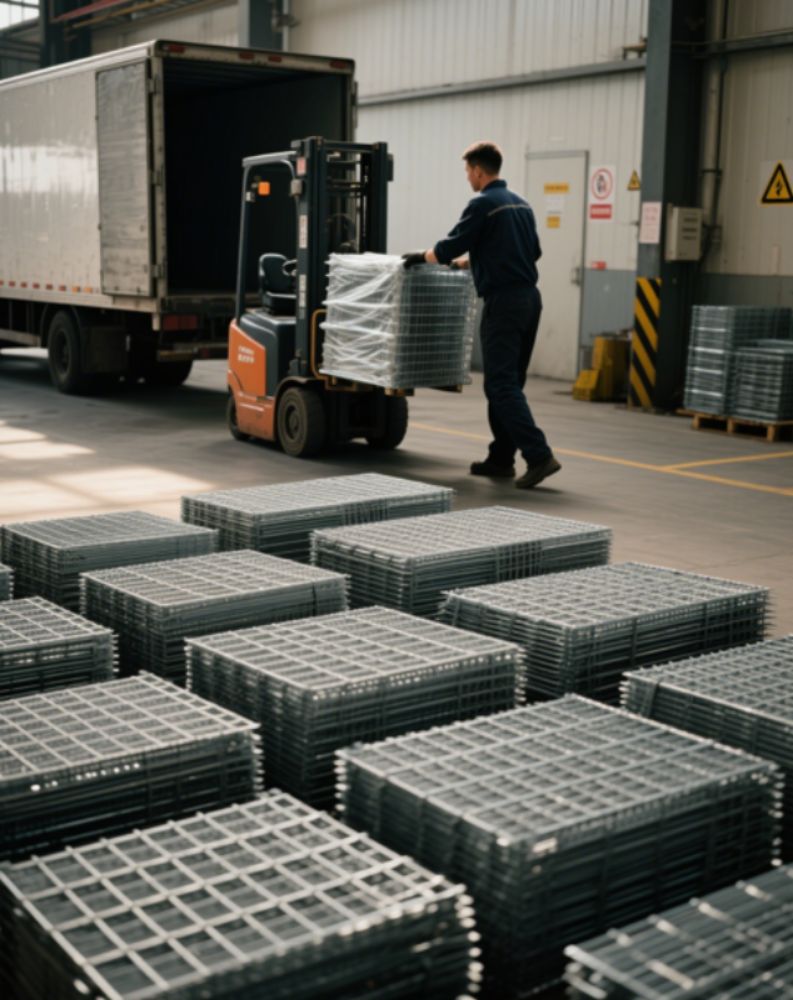
Pallet packaging combines bundling and palletizing. First, steel gratings are bundled into small bundles, then placed on wooden or plastic pallets, and finally fixed with straps or stretch film to ensure that the bundles do not shift during transportation. This method is often used in combination with forklifts or pallet jacks for loading and unloading, which improves efficiency.
Applicable Scenarios: Medium-to-long-distance transportation, large-batch steel gratings, and scenarios that require efficient loading and unloading. It is especially suitable for transportation by container or truck, where palletized goods can be easily stacked.
Advantages: High loading and unloading efficiency, good stability during transportation, and suitable for large-batch transportation. Disadvantages: Higher cost than simple bundling; the pallet itself may increase transportation volume and cost.
2.4 Anti-Corrosion Packaging
Anti-corrosion packaging is a special packaging method aimed at preventing steel gratings from rusting. Common anti-corrosion measures include: coating the surface of steel gratings with anti-rust oil or anti-rust paint; wrapping the gratings with anti-rust paper, plastic film, or VCI (Volatile Corrosion Inhibitor) film; and placing desiccants in the packaging. This method is usually used in combination with bundling, wooden case, or pallet packaging.
Applicable Scenarios: Transportation or storage in humid environments (such as coastal areas), long-term storage, or steel gratings that require high surface quality (such as decorative steel gratings). It is also essential for ocean shipping, where salt spray in the marine environment can easily cause corrosion of steel products.
Advantages: Effective prevention of rust and corrosion, ensuring the surface quality of steel gratings. Disadvantages: Increased packaging process and cost; anti-rust oil or film may need to be cleaned before use, which increases the construction workload.
3. Suggestions for Choosing the Right Packaging Method
To choose the most suitable packaging method for steel gratings, you can follow the following steps and suggestions:
3.1 Clarify the Core Needs
First, clarify the key requirements of packaging, such as whether the priority is cost control, protection performance, or loading and unloading efficiency. For example, if the project budget is tight and the transportation distance is short, bundling packaging can be chosen; if the steel gratings are high-precision and need to be transported overseas, wooden case packaging with anti-corrosion measures is more appropriate.
3.2 Conduct a Comprehensive Assessment of Transportation and Storage Conditions
Investigate the transportation mode (road, railway, ocean shipping), transportation distance, and storage environment (temperature, humidity, dust) in detail. For example, ocean shipping requires packaging with strong moisture-proof and anti-corrosion capabilities, so wooden case packaging with VCI film and desiccant is recommended; short-distance road transportation can use simple bundling or pallet packaging.
3.3 Combine the Characteristics of Steel Gratings
According to the type, specification, and surface quality requirements of steel gratings, select targeted packaging methods. For example, special-shaped steel gratings need customized wooden cases to ensure that they are not deformed; small-size and light-weight steel gratings can be bundled in batches and placed on pallets to improve transportation efficiency; high-precision steel gratings need to add padding in the packaging to avoid collision and scratch.
3.4 Balance Cost and Protection
On the premise of ensuring that the steel gratings are not damaged, try to choose cost-effective packaging methods. For example, if long-distance transportation is required but the budget is limited, pallet packaging combined with anti-rust film can be chosen instead of expensive wooden case packaging; if the storage time is short and the environment is dry, simple bundling can be used to reduce costs.
4. Conclusion
Choosing the right packaging method for steel gratings is a comprehensive decision-making process that needs to consider transportation and storage conditions, the characteristics of steel gratings, and cost control requirements. By clarifying core needs, conducting in-depth assessments of actual conditions, and combining the characteristics of different packaging methods, you can select a packaging solution that is both practical and economical. Proper packaging not only protects the quality of steel gratings but also improves transportation efficiency and reduces overall project costs. If you have special needs for steel grating packaging, it is recommended to communicate with professional packaging and transportation companies to customize the most suitable solution.


