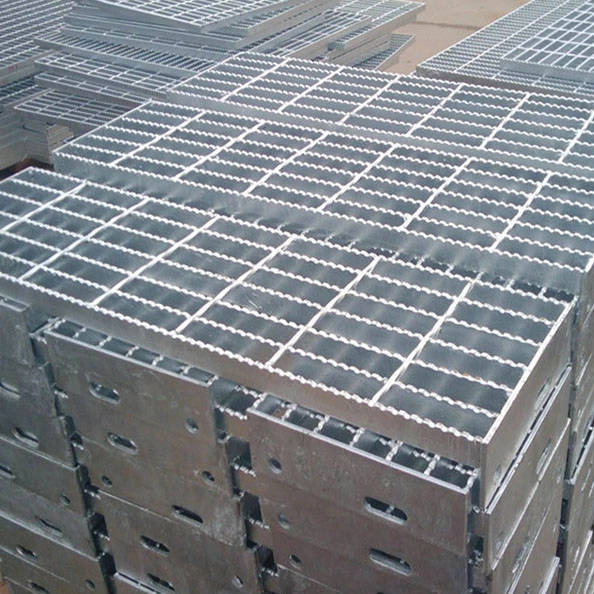
Mobile ramps are indispensable in logistics, construction, warehousing, and accessibility scenarios, serving as a critical link for bridging height differences and enabling smooth movement of goods, equipment, and people. However, the reliability of a mobile ramp—its ability to ensure safety, withstand heavy loads, and adapt to harsh environments—ultimately hinges on one core component: steel grating. More than just a surface material, steel grating acts as the "backbone" that underpins every aspect of a mobile ramp’s performance. Below is a detailed breakdown of how steel grating fulfills this pivotal role, with clear stratification of its key advantages.
1. Safety Foundation: Steel Grating Guarantees Stable Traction in All Environments
Safety is the primary prerequisite for any mobile ramp, and steel grating lays the most solid foundation for safe use through its unique structural design. This advantage can be further divided into two core layers:
1.1 Anti-slip performance that adapts to complex conditions
Unlike solid steel plates or wooden surfaces that easily become slippery when wet, steel grating features an open grid structure combined with a textured surface. The raised edges of the grating bars increase friction between the contact surface (such as forklift tires, wheelchair wheels, or pedestrian shoes) and the ramp. Even in rainy, snowy, or icy conditions, or when oil, water, or debris is spilled on the surface, this anti-slip design effectively prevents slipping and skidding, ensuring the stability of movement for both equipment and personnel.
1.2 Efficient drainage and debris removal to avoid safety hazards
The open grid gap of steel grating allows rainwater, snowmelt, and spilled liquids to drain quickly, without pooling on the ramp surface. At the same time, small debris such as sand, gravel, and dust can also fall through the gaps, avoiding the risk of slipping caused by accumulated debris. This self-cleaning characteristic ensures that the ramp surface remains safe and usable even in outdoor or harsh industrial environments, eliminating potential safety hazards caused by environmental factors.
2. Performance Core: Steel Grating Balances Load-bearing Capacity and Portability
A reliable mobile ramp must strike a balance between strong load-bearing capacity (to handle heavy goods and equipment) and portability (to facilitate transportation and setup). Steel grating, with its excellent material properties and structural design, becomes the core of this balance, which is reflected in two key layers:
2.1 Outstanding strength-to-weight ratio for heavy-duty use
Steel grating is typically made of high-quality carbon steel or stainless steel. The grid structure distributes the load evenly across the entire ramp surface, rather than concentrating it on a single point. This design enables steel grating to withstand extremely high loads—from small hand trucks to large forklifts and palletized goods—without deformation or damage. At the same time, compared to solid steel plates of the same load-bearing capacity, steel grating is significantly lighter, reducing the overall weight of the mobile ramp.
2.2 Lightweight design enhances practicality and maneuverability
The lightweight nature of steel grating makes mobile ramps easier to carry, move, and set up. For scenarios that require frequent relocation—such as construction sites, temporary logistics stations, or outdoor events—this advantage is particularly prominent. Workers can easily transport the ramp to the required location and assemble it quickly, improving work efficiency without compromising the ramp’s load-bearing reliability.
3. Durability Guarantee: Steel Grating Extends the Service Life of Mobile Ramps
Mobile ramps are often used in harsh environments, such as outdoor exposure, industrial workshops with corrosive gases, or coastal areas with high humidity. The durability of steel grating ensures that the mobile ramp can maintain long-term reliable performance, which is manifested in two aspects:
3.1 Inherent resistance to wear, corrosion, and impact
Steel itself has strong wear resistance and impact resistance, which can withstand the long-term friction and collision of equipment and goods without damage. For corrosive environments, steel grating can be further processed with surface treatments such as hot-dip galvanization or powder coating. These treatments form a protective layer on the surface of the steel, effectively isolating moisture, oxygen, and corrosive substances, preventing rust and corrosion, and greatly enhancing the material’s durability.
3.2 Low maintenance cost reduces long-term use burden
Compared to other materials (such as wood that rots easily, plastic that cracks, or aluminum that is easily scratched), steel grating requires minimal maintenance. Daily maintenance only needs simple cleaning—such as washing with water or brushing off debris—to keep the surface clean and functional. There is no need for frequent replacement or complex repairs, which reduces the long-term maintenance cost and use burden for users, making the mobile ramp more cost-effective.
4. Adaptability Support: Steel Grating Meets Diverse Application Needs
The application scenarios of mobile ramps are diverse, with different requirements for size, load, and surface performance. Steel grating’s strong customizability provides flexible support for the adaptability of mobile ramps, which can be divided into two layers:
4.1 Customizable specifications to match different load and size requirements
Steel grating can be customized according to the specific needs of mobile ramps. For example, the spacing of the bearing bars and cross bars can be adjusted: narrower spacing is suitable for pedestrian ramps or wheelchair access to ensure stability; wider spacing is suitable for heavy-duty industrial ramps to balance load-bearing and drainage. In addition, steel grating can be cut, welded, and fabricated into various sizes and shapes to fit the dimensions of different mobile ramps, ensuring a perfect fit and optimal performance.
4.2 Versatile applicability across multiple scenarios
Thanks to its excellent performance in safety, load-bearing, and durability, steel grating-equipped mobile ramps can be widely used in various scenarios. Whether it is a logistics warehouse for loading and unloading goods, a construction site for transporting construction materials, a public place for accessibility (such as wheelchair ramps), or a coastal area with high humidity, steel grating can ensure that the mobile ramp operates reliably, meeting the diverse needs of different users.