
Views: 0 Author: Site Editor Publish Time: 2026-01-14 Origin: Site


You can find the steel grating size chart below, which shows Tianhe Grating’s full product range. Size selection helps you meet safety rules and improve performance in 2026. When you read a chart, you will see terms like bearing bar spacing and cross bar spacing. These terms show how the grating is built. Tianhe Grating offers welded, press-locked, swage-locked, and serrated types.
Pick the correct steel grating size to follow safety rules and help your project work better.
Know how light duty and heavy duty grating are different so you can choose what your project needs.
Always look at bearing bar spacing and cross bar spacing to make sure the grating can hold the weight you need.
Think about things like humidity and chemicals when picking grating materials so they last longer.
Ask experts for help and use a checklist so you do not make mistakes when picking and putting in steel grating.
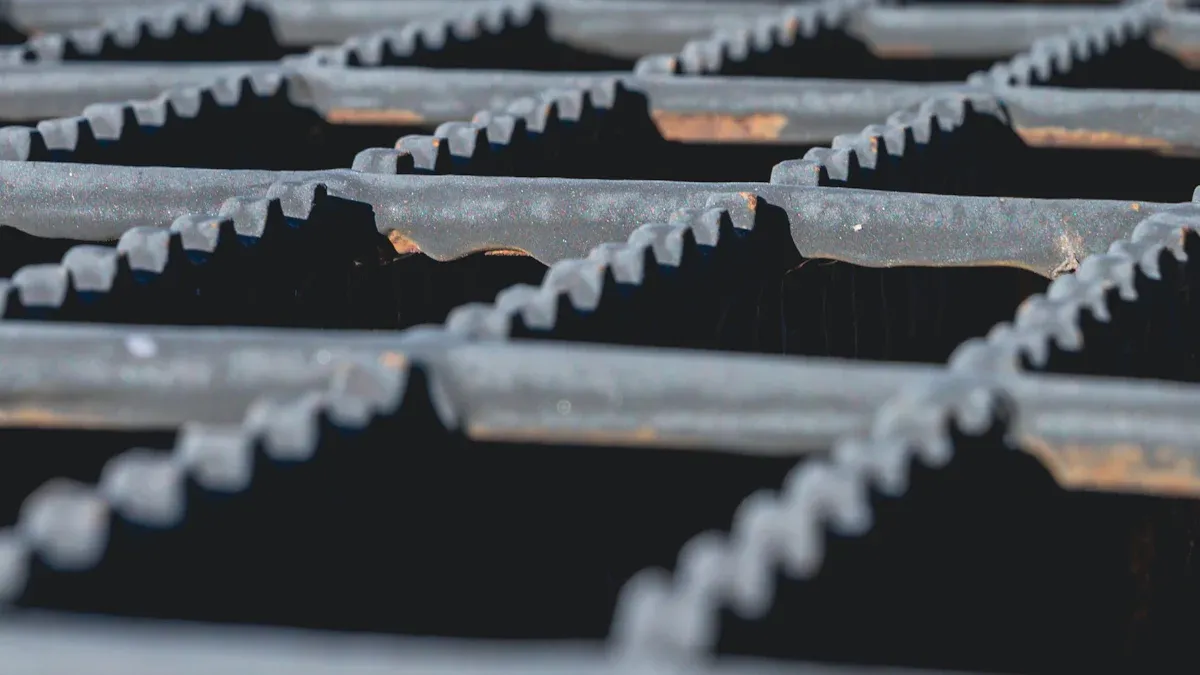
When you select steel grating for your project, you need to know the standard sizes. Tianhe Grating offers panels that fit most industrial and commercial needs. You can see the typical panel dimensions in the table below:
Panel Dimensions | Standard Size | Maximum Size |
|---|---|---|
Steel Grating | 1m × 3m | 1.5m × 6m |
You will find these sizes work well for walkways, platforms, and flooring. Many projects use these standard panels because they are easy to install and transport.
You should also know about common mesh types. Mesh type tells you how far apart the bars are. The most popular mesh types in 2026 include:
Type 19-4
Type 30-102
Here is a quick look at their specifications:
Mesh Type | Bearing Bar Spacing | Cross Rod Spacing |
|---|---|---|
Type 19-4 | 1 3/16" (19/16") | 4" (standard) |
Type 30-102 | 30mm | 102mm |
You can use these mesh types for many applications. Type 19-4 is common in industrial flooring. Type 30-102 is popular in public spaces and walkways.
You need to match the panel width and length to your project. Tianhe Grating provides a wide range of options. The table below shows the most common sizes for steel bar grating panels:
Bearing Bar (mm) | Cross Bar (mm) | Width (mm) | Length (mm) |
|---|---|---|---|
20x3 | 5x5 | 993 | 6000 |
20x5 | 5x5 | 995 | 6000 |
25x3 | 5x5 | 993 | 6000 |
25x5 | 5x5 | 995 | 6000 |
30x3 | 5x5 | 993 | 6000 |
30x5 | 5x5 | 995 | 6000 |
32x3 | 5x5 | 993 | 6000 |
32x5 | 5x5 | 995 | 6000 |
40x3 | 5x5 | 993 | 6000 |
40x5 | 5x5 | 995 | 6000 |
50x3 | 5x5 | 993 | 6000 |
50x5 | 5x5 | 995 | 6000 |
You can choose from these sizes for both light duty and heavy duty needs. Light duty panels work well for pedestrian areas. Heavy duty panels support vehicles and equipment.
Tianhe Grating stands out because you can order custom sizes. You can request ADA compliant grating for accessibility. You can also get heavy duty grates for tough environments. Most customers ask for bar grating with 1" × 3/16" bearing bars and 19/16" spacing. This size fits many industrial and commercial uses.
If you compare Tianhe Grating to other brands, you will see more size options and higher customization. You can order panels from 100 mm up to 600 mm wide. This flexibility helps you finish your project on time.
Tip: Always check the panel size and mesh type before you order. This step helps you avoid mistakes and keeps your project safe.
When you look at a steel grating chart, you see numbers that show how far apart the main bars are. These bars run the length of the panel and carry the weight. This distance is called bearing bar spacing. You need to choose the right spacing for your project. If you want more strength, pick a smaller bearing bar spacing. If you need to save weight or cost, a wider spacing works well.
Here is a table that shows common bearing bar spacing and cross bar spacing for different steel grating types:
Steel Grating Type | Bearing Bar Spacing (inches) | Construction Type | Cross Bar Spacing (inches) |
|---|---|---|---|
22-W-4 | 1-3/8" | Welded (W) | 4" |
30-W-4 | 1-7/8" | Welded (W) | 4" |
38-W-4 | 2-3/8" | Welded (W) | 4" |
11-W-4 | 11/16" | Welded (W) | 4" |
15-W-4 | 15/16" | Welded (W) | 4" |
You can also see the differences in bearing bar spacing in this chart:
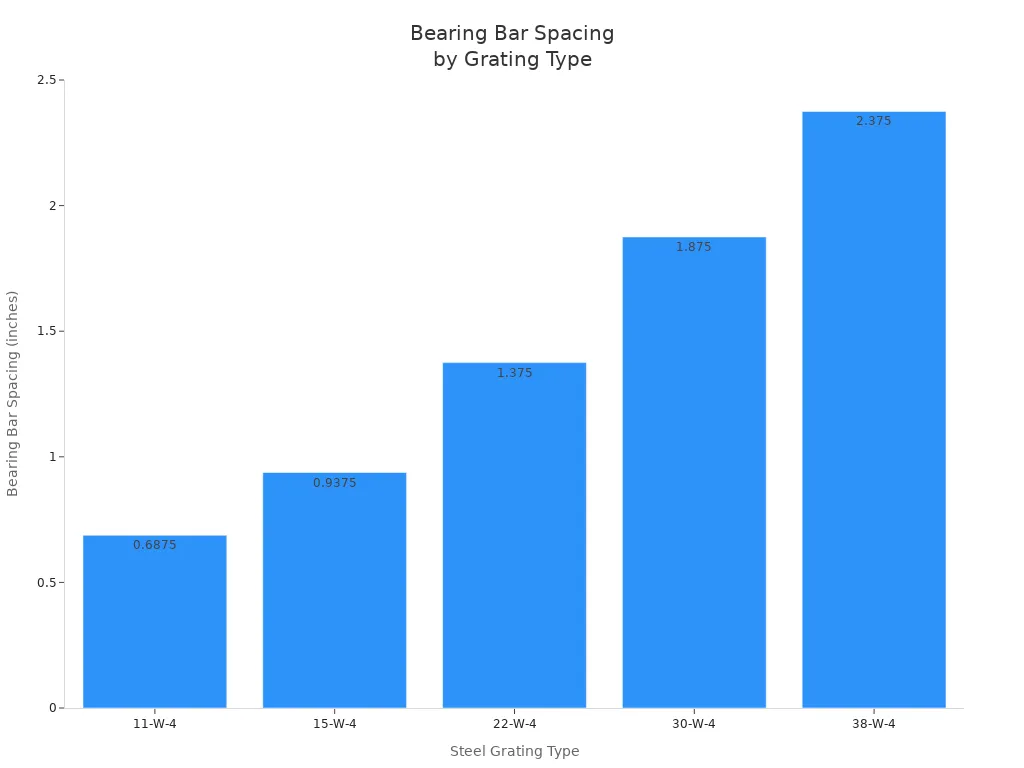
Tip: Always match the bearing bar spacing to your load needs. Smaller spacing gives you more support for heavy equipment.
Cross bar spacing tells you how far apart the bars run across the panel. These bars help keep the grating strong and stable. Most steel grating uses a standard cross bar spacing of 4 inches. You should check this number in the chart before you order.
You will see different construction types in the chart. Welded construction uses pressure resistance welding at each intersection. This method gives you high strength and works well for walkways and platforms. Press-locked grating uses hydraulic pressure to lock bars together. It gives you good lateral stiffness and can have serrated surfaces for extra grip. Swage-locked grating uses cross bars pushed into holes and locked in place. This type looks smooth and works well in places where appearance matters.
You can use welded construction for heavy-duty areas. Press-locked and swage-locked types fit medium-duty or architectural projects. Serrated surfaces help prevent slips in wet or oily spots.
Note: Always check both bearing bar spacing and cross bar spacing in the chart. This step helps you pick the right grating for your project.
You must pick the right steel bar grating size. Light duty steel bar grating is good for walkways and bridges. It also works well for platforms where people walk. These panels use thinner bearing bars. The bars are spaced farther apart. Heavy duty steel bar grating holds up vehicles and forklifts. It also supports heavy equipment. These panels have thicker bars and closer spacing. Always check the load capacity before you choose. This keeps your site safe and strong.
Tip: Pick heavy duty steel bar grating for busy or heavy areas. This helps stop damage and keeps everyone safe.
Tianhe Grating has many kinds of steel bar grating. Each kind is made for different jobs. Here is a table to help you compare:
Type of Steel Grating | Description | Typical Applications |
|---|---|---|
Welded Steel Grating | Fusion-welded for maximum strength | Heavy industrial loads, high-traffic walkways |
Press-Locked Steel Grating | Mechanical interlocking for medium-duty use | Medium-duty applications |
Swage-Locked Steel Grating | Cross bars locked into bearing bars for extra rigidity | Enhanced structural integrity |
Serrated Steel Grating | Notched surface for anti-slip performance | Wet or inclined platforms, safety in factories |
Marine-Grade Galvanized | Extra zinc coating for saltwater resistance | Offshore platform decking |
Floor Grating | Supports heavy loads, lets in light and air | Warehouse mezzanines |
Drainage Grating | Manages stormwater runoff | Parking and roadway drainage |
You can also pick safety or grip strut grating for anti-slip needs. Galvanized steel grating does not rust easily. It lasts longer in wet or chemical places.
Steel bar grating is used in many places. Here are some common uses and the best types for each:
Application Scenario | Recommended Size/Type |
|---|---|
Walkways | Carbon steel, various sizes |
Platforms | Stainless steel, custom sizes |
Stairways | Aluminum, standard sizes |
Catwalks | Welded grating, specific dimensions |
When you plan your project, think about how much weight it must hold. Also think about rust and how you will install it. Tianhe Grating can make steel bar grating just for you. You can ask for special coatings or custom sizes for special places.
Note: Always match the steel grating type and size to your project. This helps you meet safety rules and makes your installation last longer.
You have to pick the right grating size for your project. First, find out how much weight the grating will hold. Heavy-duty places, like loading docks or factory floors, need strong panels. These panels should have close bearing bar spacing and welded construction. Types like 22-w-4 and 38-w-4 are strong for heavy loads. For walkways or platforms, lighter panels with wider bearing bar spacing are good.
Always look at the load direction. The bearing bars should go across the main force. If the load goes the same way as the bearing bars, the grating gets weak. You also need to know the span length. Long spans need thicker bars and closer cross bar spacing. If you have heavy equipment wheels, use grating with reinforced welded construction and small bearing bar spacing.
People make mistakes like ignoring load direction or guessing the span length wrong. Some forget about heavy loads in one spot. Do not use non-standard materials or install the grating the wrong way. Fasten the grating tight and support it at the right spots. This keeps your site safe and stops accidents.
The environment matters a lot when you pick grating. Humidity, temperature changes, and chemicals can change how long grating lasts. High humidity or big temperature swings can cause rust. If your project is in a chemical plant or near saltwater, pick grating with special coatings or marine-grade galvanized surfaces. Welded construction with serrated bars helps in wet or oily places because it gives better grip.
You must match the grating material and surface to the environment. For outside, hot-dip galvanized grating fights rust. In places with chemical spills, stainless steel or coated grating is best. Always check the cross bar spacing and bearing bar spacing. This makes sure water and dirt can pass through easily.
You must follow safety and quality rules when you pick grating. In 2026, new rules say you must check ANSI and other metal grating standards. Make sure your grating fits the right rules for your job. Welded construction, like 15-w-4 and 30-w-4, often meets strict safety codes for factories.
Follow safe ways to install the grating. Check the grating after you put it in. Look for straight lines, strong support, and tight fasteners. Do load tests and look at the grating to make sure it is safe. Add anti-slip features, like serrated surfaces or coatings, for extra safety. Take care of the grating with regular checks and cleaning. Do not overload it and watch for damage.
Best practices include:
Safe ways to install every grating type.
Safety checks and load tests after installing.
Regular care and inspections.
Adding anti-slip features for wet or busy areas.
Checking for strong support and good surfaces.
Use this checklist to help you pick the right grating for your project in 2026:
Talk to an expert to find the right specs.
Check if the grating meets metal grating standards like ANSI.
Ask if the grating is in stock and how long shipping takes.
Get a quote to compare prices.
Know what the grating will be used for.
Pick the grating type: welded construction, heavy-duty welded, swage-locked, or press-locked.
Think about strength, weight, the environment, and how it looks.
Choose the surface: smooth, serrated, or grooved for grip.
Check load tables for 15-w-4, 22-w-4, 30-w-4, and 38-w-4 to see how much weight it holds.
Look at details like series type, product spacing, bar size and shape, percent open area, and span.
Avoid mistakes like ignoring load direction, guessing span length, missing heavy loads, using the wrong materials, or installing grating wrong.
Tip: Always match the bearing bar spacing and cross bar spacing to your load and environment needs. This step helps you avoid costly errors and keeps your project safe.
Steel grating standards will change in 2026. You can now pick from aluminum, plastic, and steel. Each material has its own strengths. Different jobs, like car factories and building sites, need different grating. How you buy grating is changing too, with more online choices. People want more options, so you can pick aftermarket or OEM products.
If you follow these tips, you can pick the best grating for your project. You will meet safety rules, get better results, and avoid mistakes.
Picking the right steel grating size and type keeps your project safe and strong in 2026. You should check the chart for load, spacing, and material every time. The table below explains why your choice is important:
Benefit | Description |
|---|---|
ADA Compliant | Follows the 1/2" opening width for wheelchair use. |
Safety | Small spacing stops tiny things from falling through. |
Durability | Welded bars can hold heavy weight. |
Aesthetics | Even look matches many styles. |
Applications | Good for walkways, public places, and factories. |
When you pick grating, think about strength, rust resistance, and safety. Look for products made for your needs and that follow rules. Always choose grating that fits your project.
Welded grating melts the bars together at each spot. This makes it very strong. Press-locked grating uses pressure to hold the bars in place. Welded grating is stiffer and holds more weight. Press-locked grating is good for lighter jobs and looks nice in buildings.
Pick the bearing bar spacing based on how much weight you need to hold. Smaller spacing gives more support for heavy things. Wider spacing is fine for light use. Always check what your project needs to be safe before you pick.
Yes, you can get custom sizes. Tianhe Grating lets you pick the panel width, length, and mesh type. You can also ask for special coatings or ADA-compliant panels. Talk to their team for a free price and help with your design.
You can pick hot-dip galvanizing to stop rust. You can also get painted or plain panels. For wet or oily places, choose serrated surfaces for better grip.


