
Views: 0 Author: Site Editor Publish Time: 2026-08-25 Origin: Site


Flooring and drainage failures in food and beverage processing carry massive stakes. Inadequate grating directly leads to audit failures, cross-contamination events, and severe workplace injuries. Facility managers constantly face a strict operational tension. You must maintain rigorous sanitation standards to meet USDA and FDA compliance. Simultaneously, you have to ensure structural durability under heavy rolling loads, extreme thermal shock, and continuous exposure to harsh washdown chemicals. Specifying the right materials demands precise engineering rather than guesswork. Facility operators must carefully evaluate alloy selection, construction methods, and surface profiles. Choosing the right configuration mitigates severe operational risks and prevents drainage failures. Implementing stainless steel grating for food industry applications requires a systematic approach to match the exact environmental demands of your production floor.
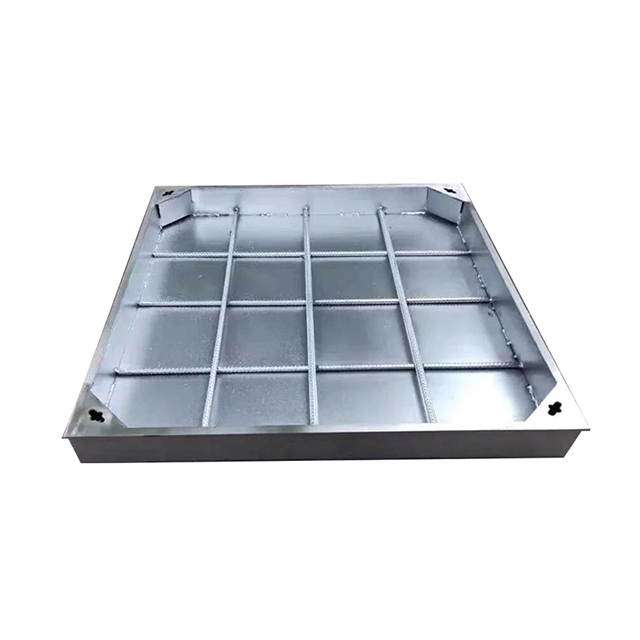
Alloy Selection is Non-Negotiable: Grade 316 stainless steel is mandatory for environments exposed to high chlorides (meat, dairy, seafood) and internal wastewater treatment, while Grade 304 suffices for less corrosive, dry-goods processing.
Sanitation vs. Traction Trade-offs: Serrated grating provides superior slip resistance in wet environments but requires more rigorous, high-pressure cleaning protocols to prevent bacterial harborage compared to smooth profiles.
Construction Dictates Cleanability: Welded bar grating is the industry standard for food processing due to the absence of mechanical joints (like those in pressure-locked or swage-locked grating) where pathogens can accumulate.
Load Capacity Requires Precision: Bearing bar depth and thickness must be explicitly engineered for the facility's specific traffic, distinguishing between pedestrian platforms and areas subjected to forklift or pallet jack loads.
Table of Contents
Traditional grating materials fail rapidly in food processing environments. Carbon steel rusts almost immediately when exposed to moisture and oxygen. This oxidation creates flaking iron oxide. Rust flakes can easily drop into processing lines or get tracked across the facility by foot traffic. Aluminum offers a lightweight alternative but degrades quickly under standard sanitation protocols. Caustic cleaners containing sodium hydroxide actively dissolve aluminum surfaces. This chemical reaction creates deep, irregular pits where organic matter hides and rots.
Fiberglass reinforced plastic (FRP) presents different but equally severe hazards. FRP resists many chemicals but lacks high thermal tolerance. Commercial ovens, fryers, and steam-cleaning protocols easily warp or melt fiberglass panels. Heavy equipment and dropped tools scratch FRP surfaces. These microscopic scratches expose the inner glass fibers. Exposed fibers harbor dangerous bacteria and resist standard mechanical scrubbing efforts. Once the surface gel coat compromises, the entire panel becomes a sanitation liability.
Stainless steel avoids these material failures through its inherent chemistry. It relies on a passive chromium oxide layer. This microscopic, invisible shield blocks oxidation and gives the metal its legendary corrosion resistance. When scratched by a dropped tool or a dragged pallet, this layer naturally repairs itself in the presence of oxygen. Stainless steel also easily withstands extreme thermal shock. You can blast it with high-pressure steam or place it directly adjacent to commercial fryers without structural degradation. It maintains its rigid form under extreme temperature fluctuations.
Choosing stainless steel eliminates recurring operational disruptions. Facilities avoid the constant replacement cycles associated with inferior materials. You maintain continuous production uptime. You also eliminate the risk of failing surprise health inspections due to degrading floor materials. The material provides unmatched long-term structural stability, ensuring your drainage infrastructure outlasts the processing equipment surrounding it.
Regulatory bodies enforce strict expectations for flooring and drainage covers. USDA and FDA guidelines mandate specific material properties for any surface in a food processing facility. Food contact and splash zone surfaces must be non-porous. They must be easily cleanable and highly resistant to corrosion. Inspectors actively look for degrading infrastructure during routine audits. A single rusted drain cover or a warped fiberglass panel can trigger a severe non-compliance report, potentially halting production.
Bacterial harborage poses the greatest risk in processing facilities. Pathogens like Listeria and Salmonella thrive in microscopic crevices. They multiply rapidly in surface pitting, mechanical joints, and scratched coatings. Once established, these bacteria form protective biofilms. Biofilms act like a microscopic suit of armor, shielding the pathogens from standard chemical sanitizers. Removing an established biofilm requires intense mechanical scrubbing and highly concentrated chemicals. Preventing biofilm formation requires eliminating the physical crevices where bacteria hide in the first place.
Washdown resilience determines a grating system's true viability on the production floor. Food plants execute daily high-pressure, high-temperature washdowns. Sanitation crews deploy aggressive foaming agents to break down stubborn proteins and fats. These chemicals often contain harsh caustics. Crews also use acidic foams to remove mineral scale and hard water deposits. The grating must endure these daily chemical assaults without degrading. If the metal pits or etches under chemical stress, it immediately becomes a bacterial breeding ground.
Drainage covers must also facilitate rapid water evacuation. Standing water encourages bacterial growth and creates severe slip hazards for personnel. The open area of the grating must accommodate high-volume liquid flow during peak washdown hours. It must allow solid debris to pass into catch basins without clogging the surface. Balancing this open area with the necessary structural support defines successful facility integration.
Establish a baseline for chemical exposure by auditing all sanitation foams and sanitizers used in the facility.
Identify the maximum temperature of washdown water and steam used on the production floor.
Map out all high-risk zones where raw proteins, fats, or heavy starches enter the drainage system.
Determine the required open area percentage to prevent water pooling during maximum flow events.
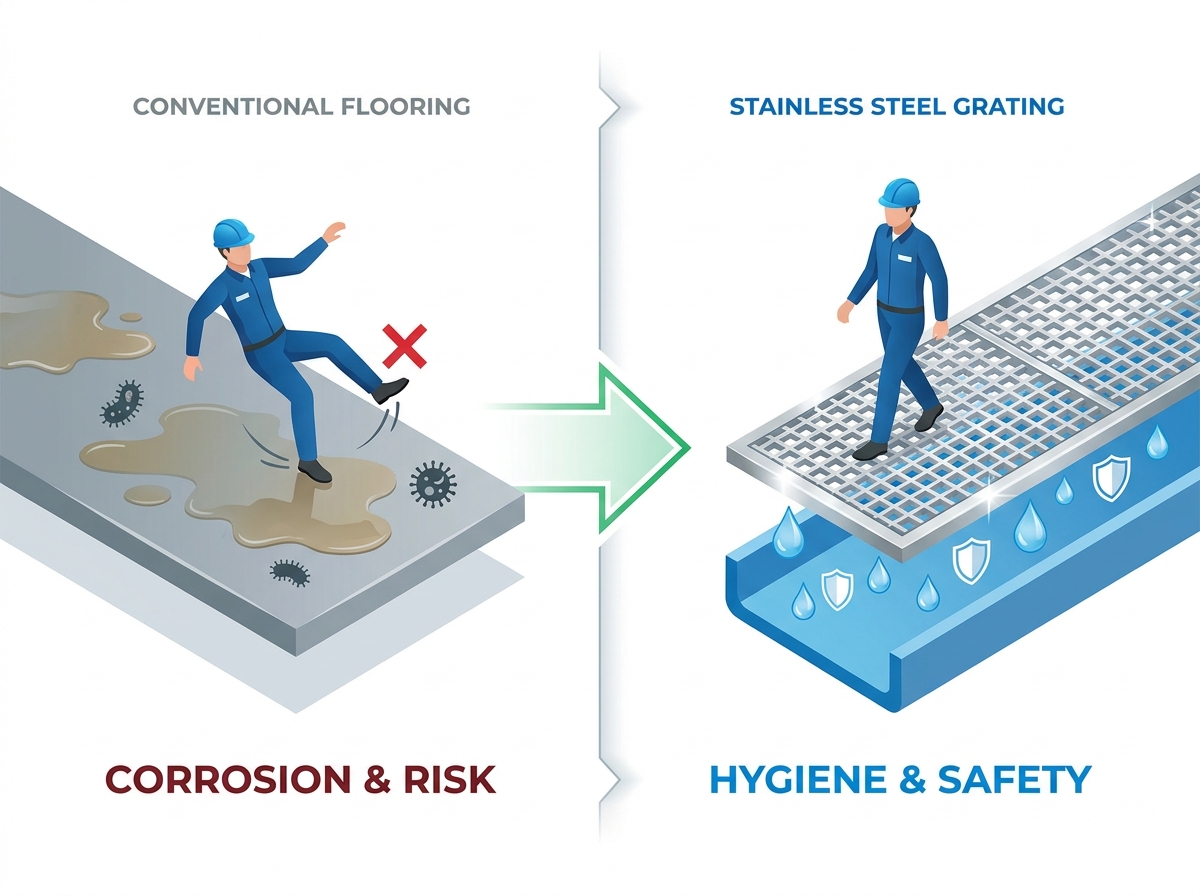
Selecting the correct alloy prevents rapid material failure and ensures long-term compliance. Facility managers generally choose between two primary austenitic stainless steel grades. Each grade serves distinct environmental conditions and chemical exposures.
Grade 304 represents the standard alloy for general industrial use. Its chemical composition includes roughly 18% chromium and 8% nickel. This mixture provides excellent baseline corrosion resistance. It withstands water exposure and mild chemical cleaning agents perfectly well. For many facilities, this alloy provides more than enough protection against daily wear and tear.
This alloy excels in specific facility zones. Bakeries and dry goods processing plants use 304 extensively because they lack heavy chemical washdowns. Beverage facilities with low chloride exposure also benefit from this grade. Many breweries install 304 grating in architectural or visible tour areas. It provides a clean, professional aesthetic while handling pedestrian traffic and occasional spills.
Grade 304 has strict limitations. It suffers from pitting and crevice corrosion in salt-heavy environments. Exposure to high chloride concentrations breaks down its protective chromium oxide layer. Once breached, the metal deteriorates rapidly, forming deep pits that harbor bacteria. You should never specify 304 for areas handling heavy brine solutions or aggressive chlorine sanitizers.
Grade 316 provides superior chemical resistance for harsh environments. Its composition mirrors 304 but includes an addition of 2% to 3% molybdenum. This specific element drastically alters the metal's performance. Molybdenum actively prevents chloride-induced pitting. It stabilizes the passive layer against aggressive chemical attacks, keeping the surface smooth and cleanable.
High-risk environments mandate the use of Grade 316. Meat packing and poultry processing plants rely on it daily to handle blood, fats, and heavy washdowns. Seafood handling facilities require it due to constant saltwater and brine exposure. Cheese manufacturing plants use it to combat acidic whey byproducts that eat through lesser metals. Internal wastewater and effluent treatment zones also demand 316. Facilities using aggressive chlorine-based sanitizers must specify this grade to prevent rapid structural decay.
Feature | Grade 304 Stainless Steel | Grade 316 Stainless Steel |
|---|---|---|
Primary Composition | 18% Chromium, 8% Nickel | 16% Chromium, 10% Nickel, 2% Molybdenum |
Chloride Resistance | Low to Moderate | Extremely High |
Ideal Environments | Dry goods, bakeries, mild beverage | Meat, seafood, dairy, wastewater |
Sanitizer Compatibility | Mild detergents, standard foams | Aggressive caustics, heavy chlorines |
Pitting Resistance | Vulnerable in brine | Highly resistant to pitting |
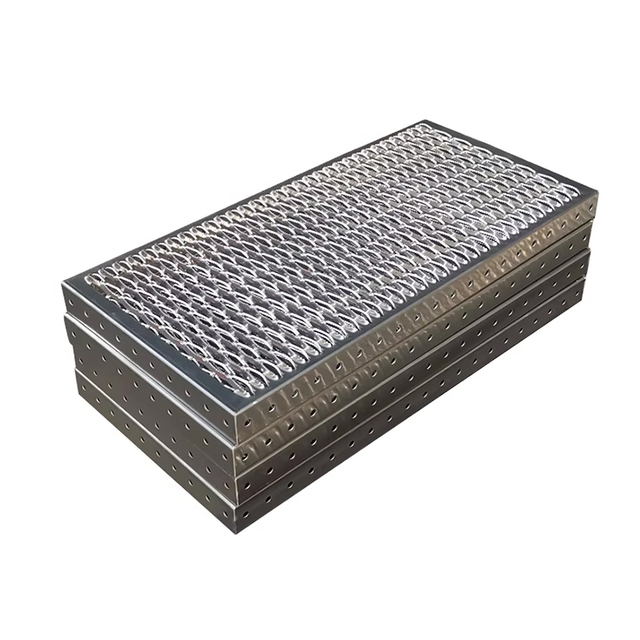
The manufacturing method dictates both the physical strength and the hygiene of the grating. Bar grating consists of a simple but highly effective structure. A series of parallel load-bearing bars handle the primary weight of traffic. Perpendicular cross bars intersect these bearing bars at specific intervals. This geometry forms a rigid, open-grid panel that allows water to pass through while supporting heavy loads.
Welded bar grating stands as the absolute industry standard for food processing. Manufacturers permanently fuse the bearing bars and cross bars together. They apply intense heat and extreme pressure simultaneously during fabrication. This forge-welding process creates a single, unified piece of metal without any secondary fasteners.
The sanitation benefits of welded construction are unmatched. The fusion process leaves no enclosed pockets. It eliminates all mechanical joints. Organic matter cannot accumulate because there are no hidden crevices for it to enter. Washdown water flows freely over the smooth, continuous intersections, making it incredibly easy for sanitation crews to clean.
Structurally, welded grating delivers the highest strength-to-weight ratio available. It handles heavy industrial applications effortlessly. The rigid panels resist twisting and warping under dynamic rolling loads. Forklifts and heavy pallet jacks can cross welded grating hundreds of times a day without compromising the panel's integrity or breaking the welds.
Alternative construction methods rely on mechanical locking rather than heat fusion. Pressure-locked grating forces cross bars into pre-punched notches on the bearing bars under high hydraulic pressure. Swage-locked grating deforms tubular cross bars to lock them into place. Riveted grating uses mechanical fasteners to connect crimped bars together.
These mechanical processes create severe harborage risks. They inherently leave micro-gaps between the intersecting bars. Moisture easily penetrates these tiny spaces. Bacteria follow the moisture. Once inside these mechanical joints, pathogens remain protected from sanitation chemicals and mechanical scrubbing. Mechanical grating types are generally unsuitable for direct food contact zones or heavy washdown areas.
Close mesh grating features tighter spacing between the bearing bars. Standard grating often uses 1-3/16 inch spacing between bearing bars. Close mesh reduces this gap significantly, sometimes down to 1/4 inch or 1/2 inch spacing.
Facilities specify close mesh for specific operational needs. It ensures ADA compliance for pedestrian walkways by preventing canes or heels from slipping through. The tight spacing prevents dropped tools, bolts, or small debris from entering sensitive machinery or drain lines below. It also provides a much smoother rolling surface for small-wheeled carts, reducing vibration and operator fatigue during material transport.
Choosing a surface profile requires balancing worker safety with sanitation efficiency. The texture of the grating directly impacts both traction and cleanability. You have to evaluate the specific hazards of each processing zone to make the right choice.
Plain surface grating features flat, untextured bearing bars. This profile offers distinct advantages for sanitation crews. It is the easiest surface to clean and sanitize. Water and foam sweep across the smooth metal without obstruction. It allows for rapid water drainage into the trench below. Smooth grating causes minimal wear on worker footwear and cart wheels, extending the life of facility equipment.
Plain grating presents a major disadvantage regarding safety. It poses a high slip risk in specific environments. When coated in animal fats, processing oils, or soapy washdown water, smooth stainless steel becomes extremely slick. Facilities must carefully evaluate the slip hazard before specifying plain grating in wet processing zones. It works best in dry areas or zones where workers wear specialized slip-resistant footwear.
Serrated surface grating features small notches cut into the top edge of the bearing bars. This texture provides maximum traction. It grips footwear aggressively, even through layers of grease. Serrated grating prevents slips in highly lubricated environments. Meat processing plants dealing with fats and blood rely heavily on this profile to keep workers upright and safe.
The increased traction comes with a strict sanitation trade-off. The serrations create hundreds of micro-ledges across the grating panel. These tiny teeth trap organic soils, proteins, and starches. Standard rinsing will not clean a serrated surface. It requires targeted, high-pressure cleaning protocols. Sanitation crews must apply foaming cleaners with longer dwell times to break down trapped matter before blasting it away with high-pressure water.
Some facilities attempt to increase traction using applied coatings. Manufacturers bond aluminum oxide or epoxy grit to the stainless steel surface. This creates a sandpaper-like texture that offers excellent initial slip resistance without the deep crevices of serrated bars.
These coatings present severe long-term risks in food plants. Harsh washdown chemicals degrade the bonding agents over time. Heavy cart traffic grinds away the grit. Eventually, the coating begins to delaminate and flake off. Peeling epoxy creates massive sanitation hazards. It traps bacteria underneath the failing coating and introduces foreign material into the processing environment. Bare stainless steel profiles remain the safer, more reliable choice for long-term compliance.
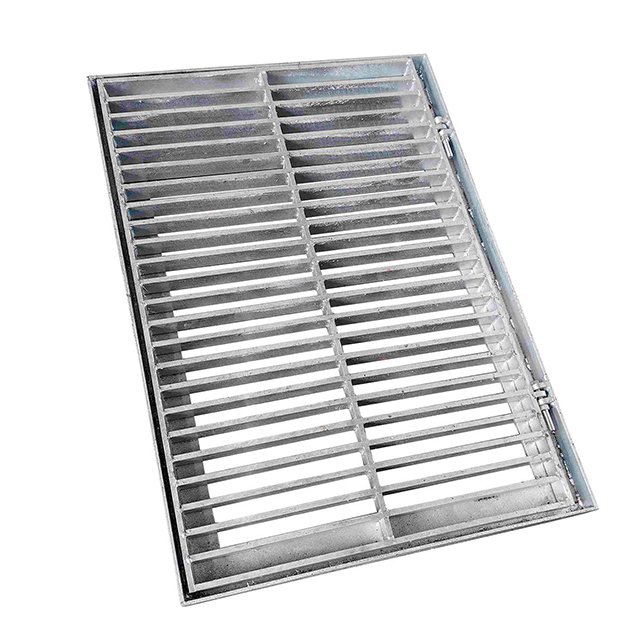
Specifying the correct physical dimensions prevents catastrophic structural failure. Grating must support the specific loads applied to it without excessive deflection. A failed grating panel can drop a forklift into a trench, causing severe injury and massive facility damage.
Engineers calculate load requirements based strictly on traffic type. Pedestrian traffic on elevated catwalks generates uniform, relatively light loads. Personnel walking across a platform rarely stress industrial grating. You can use thinner bearing bars and longer unsupported spans for simple walkways. A standard 1-inch by 1/8-inch bearing bar often suffices for foot traffic over short spans.
Rolling loads completely change the engineering math. Motorized pallet jacks and heavy forklifts generate massive dynamic point loads. A forklift carrying a full liquid tote concentrates thousands of pounds onto small, hard wheels. When these wheels cross a trench drain, the grating absorbs immense stress. Handling these loads requires thick bearing bars, often 1/4-inch or 3/8-inch thick. It requires deeper bar depths, sometimes up to 2 or 3 inches. It also requires minimizing the unsupported span length across the trench to prevent the bars from bowing under pressure.
Traffic Type | Typical Load Profile | Recommended Bearing Bar Thickness | Primary Engineering Concern |
|---|---|---|---|
Pedestrian Walkways | 50-100 lbs per sq ft (Uniform) | 1/8 inch to 3/16 inch | Deflection limits for walking comfort |
Hand Carts / Light Jacks | 300-1,000 lbs (Point Load) | 3/16 inch to 1/4 inch | Smooth rolling surface, vibration reduction |
Heavy Forklifts | 5,000-10,000+ lbs (Dynamic Point Load) | 1/4 inch to 3/8 inch | Preventing catastrophic bar yielding |
Different facility zones require distinct grating configurations. You must tailor the sizing to the specific application to ensure both safety and functionality.
Trench Drains & Grease Traps: These areas require high-volume liquid flow. They endure heavy point-loading from crossing traffic. The grating must also be light enough for sanitation crews to remove frequently for deep cleaning, often requiring panels to be cut into manageable 2-foot or 3-foot lengths.
Mezzanines and Platforms: Elevated structures prioritize structural rigidity. They must prevent debris from falling through to the production lines below. Close mesh spacing often solves this problem while providing a safe walking surface.
Stair Treads: Safety is paramount on wet stairs. Treads require the integration of visible, highly slip-resistant nosing. This defines the edge of the step and prevents catastrophic falls during rapid movement.
High-Heat Zones: Areas near commercial fryers and industrial ovens experience extreme temperatures. Engineers must account for the thermal expansion and contraction of the stainless steel panels to prevent buckling against the embedded frames.
Even perfectly specified grating can fail if installed incorrectly. Facility managers must oversee the fabrication and installation processes strictly to protect their investment.
Improper welding and fabrication ruin stainless steel. Fabricators must never cut or weld stainless steel using tools previously used on carbon steel. Grinding wheels, wire brushes, or cutting tables contaminated with carbon steel introduce free iron into the stainless surface. This contamination leads to rapid surface rusting, commonly known as rouge. Facilities must insist on dedicated stainless-steel fabrication environments and verify the manufacturer's quality control processes.
Passivation is an absolute requirement after any fabrication. Welding burns away the protective chromium oxide layer, leaving the heat-affected zone vulnerable to immediate corrosion. Chemical passivation restores it. Technicians apply nitric or citric acid solutions to the welded areas. This acid bath removes free iron and accelerates the reformation of the passive shield. Skipping passivation guarantees premature corrosion at the weld joints, leading to structural failure and audit violations.
Installation tolerances dictate long-term durability. Grating panels must sit perfectly flush within their embedded frames. Improper seating in drain trenches causes the grating to rock as traffic crosses it. This constant movement creates metal fatigue. The impact forces multiply as the grating slams against the concrete frame. Eventually, the bearing bars crack and fail under dynamic loads. Installers must level the frames precisely before pouring the surrounding concrete and ensure the grating sits flat without any wobble.
Specifying grating for the food industry is a critical compliance and safety decision. It extends far beyond basic structural engineering. The right grating protects your product from contamination and your workers from injury. It ensures you pass rigorous health audits without friction and maintains your production uptime.
Your decision matrix should be clear and systematic. Choose 316 welded serrated grating for high-risk, wet, fatty, or wastewater environments. This combination provides maximum chemical resistance and worker traction. Choose 304 welded smooth grating for dry, low-corrosion zones where rapid cleaning takes priority over aggressive slip resistance.
Audit your current chemical washdown protocols to identify the exact caustics, acids, and sanitizers used daily.
Calculate your maximum dynamic rolling loads with a licensed structural engineer to determine the necessary bearing bar depth and thickness.
Evaluate the slip hazards in each processing zone to decide between smooth or serrated surface profiles.
Request certified Material Test Reports (MTRs) from grating manufacturers before issuing a purchase order to verify alloy composition.
Establish a strict inspection protocol during installation to ensure frames are level and grating panels do not rock under traffic.
For food processing and other demanding industrial projects, Foshan Tianhe Steel Grating Co., Ltd specializes in the development and production of steel grating and related metal products. With experience in customized design, manufacturing, and quality control, the company supports grating solutions tailored to different load, drainage, corrosion resistance, and installation requirements.
A: Grade 316 is the best choice for wet, high-chloride, wastewater, or meat processing environments due to its molybdenum content, which prevents pitting. Grade 304 is highly effective and commonly used for dry, mild environments like bakeries or low-chemical beverage facilities.
A: Yes, serrated grating meets USDA requirements. However, it demands stricter, high-pressure cleaning protocols. Sanitation crews must use appropriate foaming agents and allow sufficient dwell time to ensure all organic matter is fully removed from the micro-ledges of the serrated teeth.
A: Welded grating completely eliminates mechanical joints. The heat-fusion process creates a seamless intersection between bars. This prevents the formation of micro-crevices where moisture, organic debris, and dangerous pathogens like Listeria and Salmonella can hide and multiply.
A: Yes. Stainless steel grating easily supports heavy forklift traffic provided it is explicitly engineered for those loads. You must specify heavy-duty grating with appropriately sized bearing bar thickness and depth to handle the dynamic point loads generated by hard forklift wheels.
A: Ensure the grating undergoes proper chemical passivation after any cutting or welding to restore its protective chromium oxide layer. Additionally, strictly avoid cross-contamination by never using tools that have previously touched carbon steel during the installation process.
A: There is no single standard spacing. The spacing must balance maximum liquid and debris flow for efficient drainage with the structural support required for the specific type of cart or foot traffic crossing the trench.


